🌍 Is AI Governance Being Split by Design - or by Competition?

The landscape of global AI governance changed dramatically over the past two weeks.
Two major international AI governance initiatives have officially emerged, each reflecting a different vision for how artificial intelligence should be governed, developed, and shared.
If you want to understand where global AI diplomacy is heading, pay attention to these two new pillars.
🏛️ Two Emerging Pillars of Global AI Governance
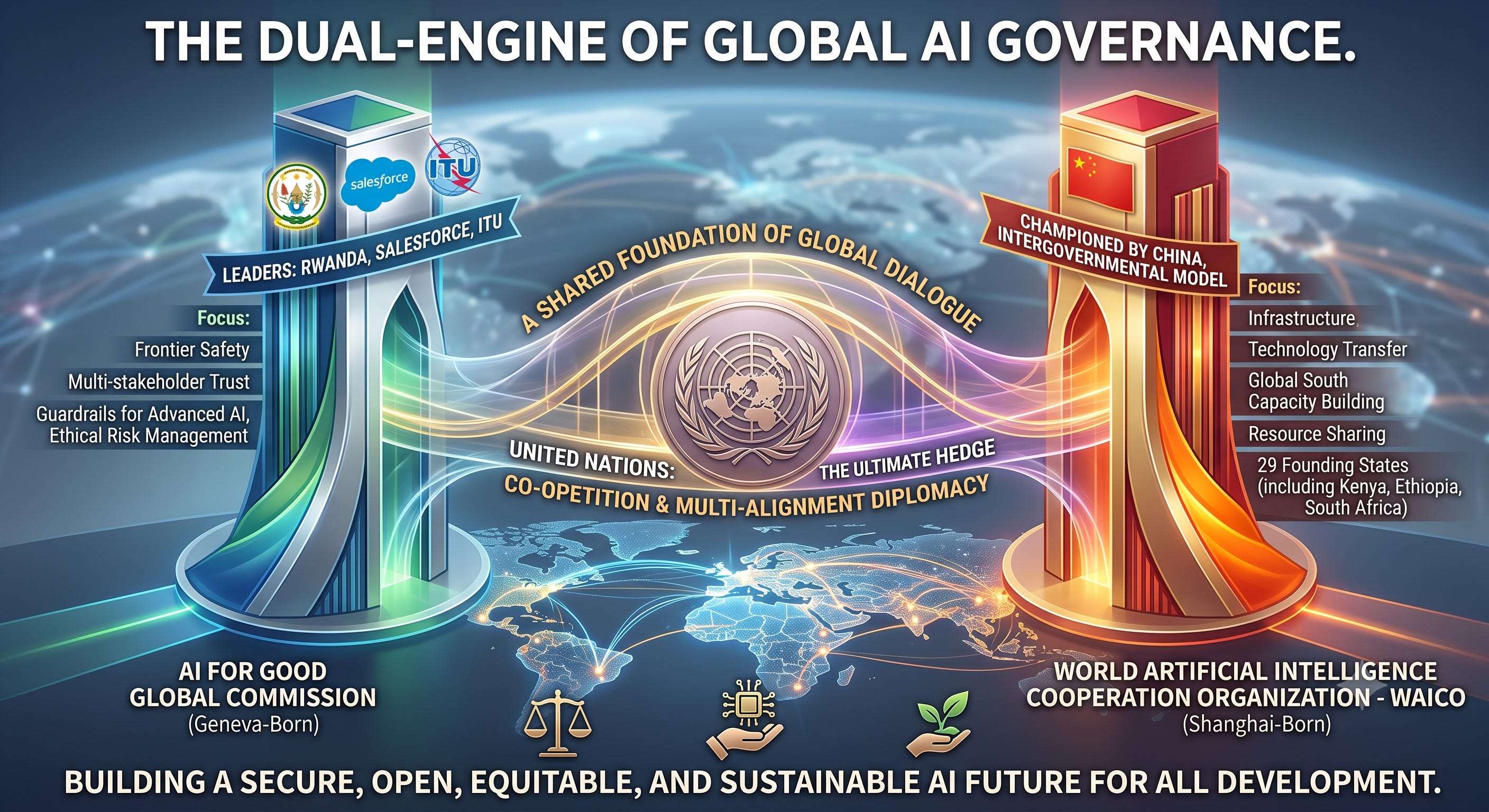
1. AI for Good Global Commission (Geneva)
Co-chaired by Rwandan President Paul Kagame and Salesforce CEO Marc Benioff, with ITU Secretary-General Doreen Bogdan-Martin serving as Vice-Chair, this initiative is backed by many of the world’s frontier AI companies—including Microsoft, Google, Anthropic, and NVIDIA.
Its focus is clear:
• Building public trust in AI
• Establishing governance guardrails for frontier models
• Promoting safe, secure, and responsible AI deployment
2. World Artificial Intelligence Cooperation Organization (WAICO) (Shanghai)
Launched under China’s leadership with 29 founding member states across Asia, Eurasia, and Africa, WAICO has been established as an independent intergovernmental organization.
Its priorities are equally clear:
• Expanding AI infrastructure access
• Accelerating technology transfer
• Building AI capacity across the Global South, including thousands of training opportunities
• Reducing barriers to AI adoption
Although both initiatives aim to advance AI globally, they emphasize different pathways to achieving that goal.
🧠 The Bigger Question
Are we witnessing the emergence of competing spheres of technological influence?
Or are these simply complementary approaches responding to different global priorities?
Perhaps the answer is somewhere in between.
One framework places greater emphasis on governance, safety, and frontier AI oversight.
The other prioritizes accessibility, infrastructure development, and technology diffusion.
Rather than a single global model, we may be entering an era of multiple AI governance architectures.
🤝 Must Countries Choose a Side?
I don’t believe so.
In fact, forcing countries into exclusive camps could undermine global AI progress.
Several signals suggest that cooperation and competition will coexist.
The United Nations is engaging with both initiatives. While the ITU plays a central role in the AI for Good Global Commission, UN Secretary-General António Guterres also participated in WAICO’s launch.
Likewise, global technology companies increasingly operate across multiple ecosystems rather than within a single geopolitical bloc.
The future may therefore be defined less by division and more by strategic multi-alignment.
🌍 An Opportunity for Africa and the Global South
For countries across Africa—and for forward-looking enterprises—the opportunity is not to become passive rule-takers.
It is to become strategic bridge-builders.
That means embracing world-class AI governance, safety, and standards while simultaneously leveraging investments in infrastructure, talent development, and technology transfer.
Those able to navigate both ecosystems may be best positioned to shape the next phase of AI adoption.
🚀 From Principles to Institutions
Whether these developments ultimately create fragmentation or healthy competition remains to be seen.
What is clear, however, is that global AI governance is entering a new chapter.
We’re moving beyond broad ethical principles toward institutional structures with real influence over how AI is developed, governed, and deployed.
The era of passive observation is ending.
The era of multi-aligned AI diplomacy has begun.
What do you think?
Are these parallel initiatives creating healthy checks and balances for global AI, or are they the beginning of a fragmented digital order?
I’d love to hear your perspective.
#ArtificialIntelligence #AIGovernance #AIDiplomacy #GlobalSouth #DigitalTransformation #TechPolicy #AIforGoodGlobalCommission #WAICO #Innovation #FutureOfAI